London is one of the largest data centre markets in Europe. From financial services and law firms to schools, retailers and fast-growing tech businesses, organisations across the capital rely on secure, resilient spaces to house their servers and network equipment. Whether you need a brand-new comms room, a server room upgrade or a full data centre fit-out in London, getting the construction right is what keeps your systems running 24/7.
In this guide, the team at Richmond Traders explains what a data centre build involves, the key stages of a project, typical challenges in London and how to choose the right contractor. If you already have a project in mind, see our dedicated data centre construction in London service page.
What Is a Data Centre Fit-Out?
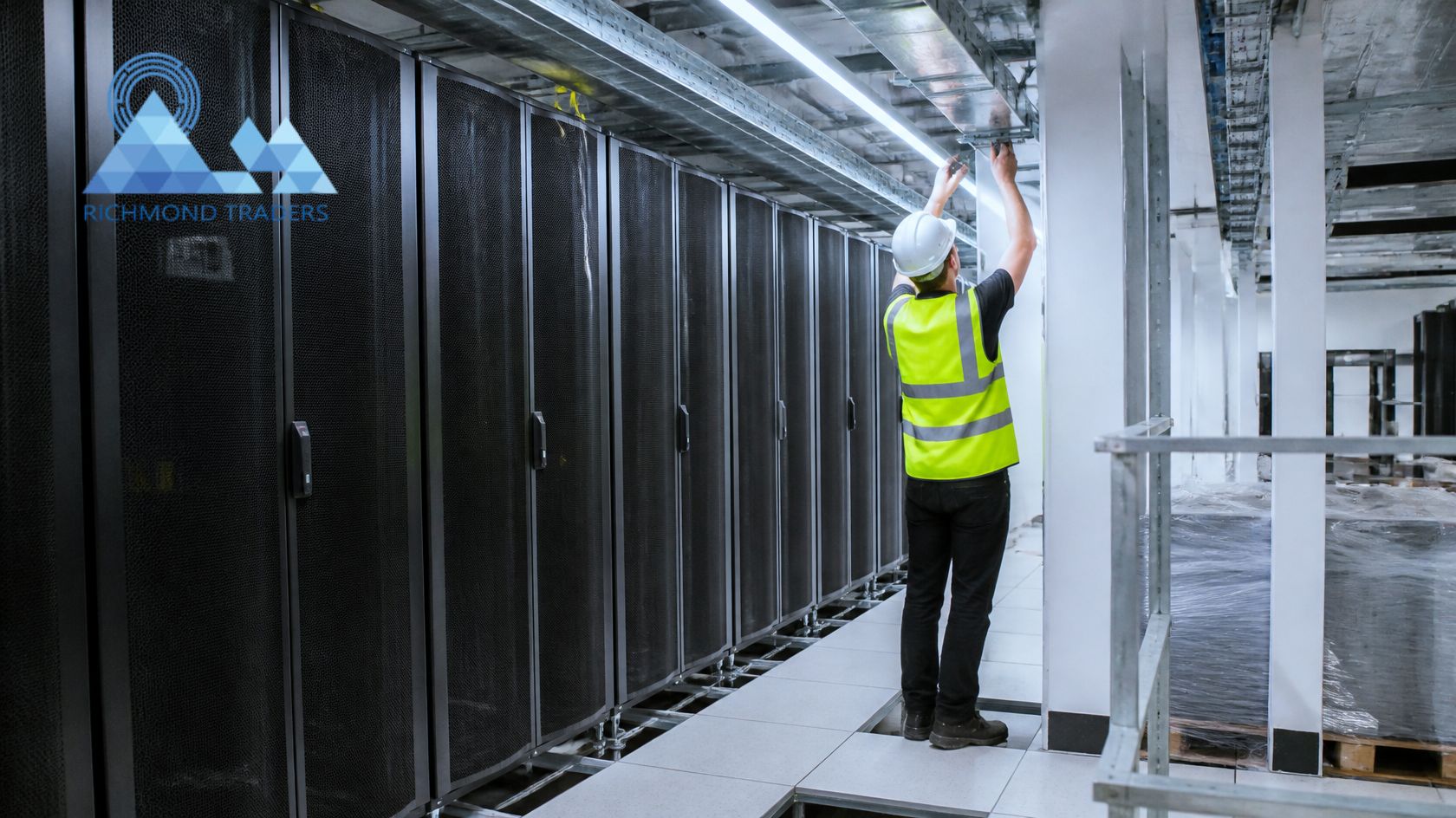
A data centre fit-out is the process of turning a shell building, office floor or existing room into a controlled environment for IT equipment. It covers the building works, mechanical and electrical (M&E) services, cooling, fire protection and security needed to keep servers safe, cool and powered at all times.
Projects range in scale:
- Comms rooms and server rooms inside offices, schools and commercial buildings
- Edge and micro data centres for businesses that need computing power close to their users
- Data hall refurbishments to increase capacity, efficiency or resilience
- New-build data centre construction and colocation spaces across London and the M4 corridor
Key Elements of Data Centre Construction in London
1. Raised Access Flooring and Containment
Raised access floors create space beneath the racks for power cables, data cabling and airflow. Combined with overhead cable trays and hot or cold aisle containment, they keep the space organised, safe to maintain and easy to expand in future.
2. Power and Electrical Infrastructure
Reliable power is the heart of any data centre. A typical fit-out includes dedicated distribution boards, uninterruptible power supplies (UPS), generator connections, earthing and bonding, and power distribution to each rack. All electrical work should be designed and installed by qualified engineers to BS 7671 – our commercial electricians work alongside our construction team on every project.
3. Cooling and Air Conditioning
Servers generate a lot of heat. Precision cooling, in-row cooling units and well-designed airflow prevent hot spots and equipment failure. Getting the cooling design right also has a major impact on running costs and energy efficiency (PUE).
4. Fire Detection and Suppression
Data centres need early-warning smoke detection and gas-based fire suppression systems that protect equipment without water damage, together with fire-rated walls, doors and compartmentation to meet Building Regulations.
5. Physical Security and Access Control
Secure doors, access control, CCTV and visitor management protect sensitive data and equipment. Since 2024, UK data centres have been designated as Critical National Infrastructure, which makes physical security more important than ever.
6. Structured Cabling and Racks
Neat, labelled copper and fibre cabling, correctly installed server racks and cable management make the facility easier to run, upgrade and troubleshoot.
The Data Centre Construction Process: Step by Step
- Site survey and feasibility – assessing the building, floor loading, available power and access.
- Design and planning – agreeing layout, resilience level, cooling strategy and compliance requirements.
- Strip-out and building works – partitions, fire-rated walls, ceilings, doors and raised floors.
- M&E installation – power, UPS, cooling, fire suppression, lighting and security systems.
- Cabling and rack installation – structured cabling, containment and racks.
- Testing and commissioning – full load testing of power and cooling before go-live.
- Handover and aftercare – documentation, O&M manuals and ongoing maintenance support.
Common Challenges for London Data Centre Projects
- Power availability – grid capacity is limited in parts of London, so early engagement on power supply is essential.
- Space and access – city-centre buildings often have tight access, limited loading and restricted working hours.
- Live environments – many upgrades take place while existing systems must stay online, which requires careful phasing.
- Planning and compliance – projects must meet Building Regulations, fire safety, CDM 2015 and local authority requirements.
- Energy efficiency – rising energy costs and sustainability targets make efficient cooling and power design a priority.
How to Choose a Data Centre Contractor in London
When comparing contractors for your server room or data centre project, look for:
- Proven experience in commercial construction and technical environments
- In-house or closely managed electrical and M&E teams
- Full health and safety documentation, including RAMS and CDM compliance
- Appropriate insurance, warranties and accreditations
- Clear, itemised quotations and realistic programmes
- The ability to work around live operations and out of hours
You can review our warranties, insurance and credentials and health and safety policy online.
Why Choose Richmond Traders for Your Data Centre Project?
Richmond Traders is a Twickenham-based construction company delivering commercial construction services across Richmond, South West London and London. We combine building, electrical and fit-out expertise under one roof, so you have a single point of contact from survey to handover. Alongside data centre and server room work, we also deliver office refurbishments in London, which means we can upgrade your comms room as part of a wider workplace project.
- One team for building works, electrical installation and fit-out
- Experience working in occupied and live commercial buildings
- Safe, compliant and fully documented delivery
- Clear communication and transparent pricing
Frequently Asked Questions
How long does a data centre fit-out in London take?
A small server room or comms room upgrade can often be completed in a few weeks. A full data hall fit-out or refurbishment usually takes several months, depending on the size of the space, power availability, equipment lead times and whether the facility must stay live during the works.
Can you upgrade a server room while our systems stay live?
Yes. Live-environment works are planned in phases, with method statements, risk assessments, out-of-hours working and strict access control, so critical equipment keeps running while the space is improved.
What is the difference between a server room and a data centre?
A server room is usually a dedicated room inside an office building housing a business’s own IT equipment. A data centre is a purpose-built or converted facility designed to host large volumes of IT equipment, with resilient power, cooling, fire protection and security at scale.
Do you work outside Richmond?
We are based in Twickenham and work across Richmond, South West London and the wider London area, including Kingston, Teddington, Hampton, Isleworth, Ealing and central London commercial sites.
How much does a data centre fit-out cost?
Costs depend on the size of the space, the resilience level required, the power and cooling load per rack, and the condition of the existing building. We provide a detailed, itemised quotation after a site survey so there are no surprises.
Planning a Data Centre or Server Room Project in London?
Whether you need a new comms room, a server room upgrade or a complete data centre fit-out, Richmond Traders can help. Call us on 07448 992848 or get in touch online to arrange a site survey and quotation.